A bill is making its way through the levels of the British parliament’s upper house that would grant holders of copyrighted material to mandate injunctions against websites that post pirated files. According to one BusinessWeek article, “The proposed law would allow copyright-holders to seek injunctions blocking Web sites alleged to be hosting pirated content.” This possible decree does not sit well with some of the internet’s most influential organizations. Google, Yahoo, eBay, and Virgin, joined by various scholars, composed a letter to the Financial Times. In this written entreat, the band of websites claims that the injunctions will grossly compromise our right to freedom of speech and the abilities the internet currently possesses aided by this right.
While I do not think the posting of downloadable content is protected under our freedom of speech, I do believe that by shutting down these websites or stripping them of their content this bill is slicing the principle of the open internet. Instead of simply hacking down these websites like entangled weeds, the companies seeking to halt their practices should work with websites and institutions like BitTorrent or The Pirate Bay to develop deals that would either bring about fewer downloadable items (and possibly more streaming as an alternative) or added incentives to buying the items (special features).
BusinessWeek article (http://www.businessweek.com/ap/financialnews/D9EBR9180.htm)
Sunday, March 14, 2010

The Hurt Locker and BitTorrent
Because of the recent buzz surrounding the wildly successful Academy Award sweep The Hurt Locker achieved (a total of six Oscars, including Best Picture and Best Director), the movie-going public was eager to see what made this film just so worthy of the film industry’s highest accolades. There were several mediums for interested viewers to watch this film. The first is the most-desired result by the film industry and those who would and will profit from The Hurt Locker: theaters are still screening this film. In addition to tickets sales, the movie can benefit from its sales on DVD and Blu-ray. The last option is to stream or download the film, courtesy of notorious websites such as BitTorrent. According to TorrentFreak, this movie has been downloaded 1 million times since the film scored at the Oscars. Though this number is dishearteningly high, some good may come out of downloading the film. Currently, (and in these trying economic times) viewers like to “preview” content before they invest in it – check a book out of the library before purchasing a copy, playing a free video game demo before ordering it, ripping a CD before supporting the band and buying it. If people are “previewing” The Hurt Locker online, with a sub-par quality and whatever sound their laptop can muster, they may feel compelled to purchase the movie and enjoy the special features – a high-quality visual and sound emission and a commentary by now-elite director Kathryn Bigelow and writer Mark Boal. The purchase could be considered an investment, and for some, an addition to their collection of remarkable films. This logic may in fact have some validity – DVD sales have skyrocketed and topped several top-seller lists.
TorrentFreak Article (torrentfreak.com/oscar-win-boosts-hurt-lockers-piracy-numbers-100312/)
TorrentFreak Article (torrentfreak.com/oscar-win-boosts-hurt-lockers-piracy-numbers-100312/)
Saturday, March 13, 2010
Data Piracy Criminalization Prevention
Data piracy is an increasingly prevalent topic in the world today. With many people pirating movies, music, games and more, the rise of lawsuits filed by the owners of the intellectual properties are staggering. Even more surprising are the amounts of money won at trial with some ranging in the thousands to others in the millions, amounts which the defendants cannot possibly pay. The criminalization of data piracy is now being debated whether or not the fines and penalties associated with the act are justified. Clearly something should be done to curb piracy, however penalizing selected individuals to act as "examples" is clearly not an acceptable solution, rather than dealing with the problem after it has occurred something needs to be done to stop it from happening in the first place.
When I bought Daft Punk's sophomore album Discovery - well more than likely not me but my parents (this was 2001; I was nine) - it came with a "Daft Club" membership card, which granted access to Daft Punk's online music service. This website featured remixed songs, a live recording of Daft Punk and an a cappella and instrumental version of "Harder, Better, Faster, Stronger." At this time I had no reason to see this as a cool "extra" that I got from buying the CD. However, this is exactly the type of thing that artists and companies need to do. Instead of worrying about what to do with people who pirate their intellectual property they should focus on how to convert those pirates into customers by making the item more appealing with something that cannot be pirated.
The difficulty comes from finding out what to include that would make people want to buy the product instead of pirating it. Some bands have included t-shirts, posters, or other extras along with the purchase of their album, while others have gone a step further and offered incentives such as access to concert tickets earlier, potential future downloads, or even early entry to their concerts. Some videogames have been packaged with a code that grants access to free downloadable in-game content, which would otherwise cost fifteen dollars. Movies on the other hand, by buying Blu-Ray discs, offer far superior visuals and audio compared to pirated versions.
By pursuing lawsuits against individuals involved in the piracy of protected intellectual property the companies and artists are only distancing themselves from their fan base and putting themselves in a negative light. In most cases the people they charge cannot possibly pay the expected amount granted. Likewise, the assumption that by convicting and charging people who download and/or distribute data it will convince others no to do so, as the risk is too much. Data piracy is still very active today with people using torrents and file uploading sites to download music, movies, programs, etc. The only feasible way to eradicate piracy would be by putting impossibly draconian measures in place, something that would have the entire internet community up in arms about the injustice of the situation.
This is not to say there are not artists who "support" downloading. In a blog post on Portugal. The Man's website an article titled "The Leak. The Response. The Review." talks about their stance on downloading music.
"Please don’t feel guilty about downloading. Download the album if you want to hear it in advance of the purchase and make sure you like it and in doing so keep in mind that some of our favorite records have been growers  . Download the album if you have no idea who we are and a friend or respected music blog or magazine recommend it. Download the album if you live in a place where shipping will end up costing you more than the record (We don’t have distribution everywhere.). Download if you honestly don’t have the money, we understand the times. "
However encouraging those words are that's not to say that there isn't a "dark side" to this whole issue. In an earlier post John, the singer for Portugal. The Man, talked about several of the downsides of piracy. I'm sure we all know the feeling of anticipation or excitement for something. Perhaps a trip coming up, a movie premiere at midnight, an album release, whatever, which had you waiting for the day it happened, marking the calendars. That "hype", that excitement seems lost today. If an album leaks you just type in google "------ torrent", "------ download", "------ mediafire/megaupload/rapidshare" whatever, and you have it. There's no driving to the store after work to see if they have it, waiting for the mail to come to see if the package is here, it's just lost.
The other problem is that you're taking their work, time, creativity, genius all for granted by pirating whatever they made. Take this quote from Portugal. The Man's singer's post, "I sleep on a hard wood floor in the house of people I did not know before Ryan’s joining of this band. I sleep on this floor with Ryan and Ian, our tour manager. Our tour manager sleeps on this floor with us because he will not let us pay him when we cannot pay ourselves." They're people, their music is their work and how they get any money, if you download the music you don't give anything to them. You might say you're fighting corporation "fat cats" who are in turn cheating the artist, yet today when record sales are down (I'll use Grizzly Bear's Veckatimest (first auto search was "Grizzly Bear Veckatimest mediafire" with "Grizzly Bear Veckatimest torrent" in a close second) was about 33,000, probably a bit more now) recording companies work with the artists fairly now. Also remember that less money means less promotion, less money behind the release, less money for a tour and less chances for you to see them. For other media it's the same, but could also influence the possibility of a sequel, or continuation of a director's or company's career.
In short, buy the item if you can, support the artists, creators, the people whose job it is to bring you these things. If they can incentivize these products to make you want them even more, great, since it should help convince more people to buy them. However, companies going after downloaders for large sums of money isn't going to solve anything, nor will continuously downloading items. Remember, their future is in your hands. If you buy the item you support their continued success for the things you like.
Thursday, March 11, 2010
What Does This Picture Attempt to Convey? (Fedor)
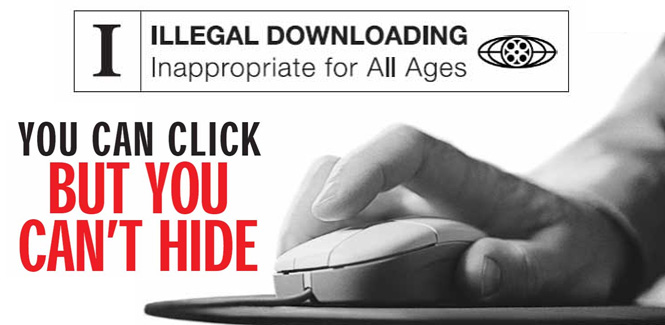
It attempts to convey the message that illegally downloading is wrong and inappropriate for anyone of any age. It’s basically saying that no one has the right to download any copyrighted content without the permission and consent of the owner no matter what their age, status or reason. The bold red words are significantly bigger than other text within the picture which emphasizes the point that people who download illegally run the risk of getting caught and it’s also a technique to make people fear downloading illegally as they 'can't hide'.
The fascination about the internet is that you can do a lot of things and no one will ever catch you for it. Write an offensive essay online, curse someone out, or write a horrible song about someone. However, there are certain levels where someone will get caught. The phrase ‘You Can Click But You Can’t Hide’, basically means that you are allowed to click on almost anything on the internet but one way or another, no matter where you will escape to, they will catch you. Thanks to ‘Internet’, the police force and FBI can catch people a lot faster than they could a long time ago. With the Internet, they can track where you stayed, where you used your credit card. They can quickly put up reward signs all over the world in a matter of seconds and chances are you will get caught, you will get sued and you will get thrown in jail. You can click but you’ll never be able to hide anywhere.
Dissection of a Text
Is online piracy a good thing?
(http://www.cnn.com/2009/SHOWBIZ/Movies/04/17/online.piracy.for.against/index.html)
This article on CNN had both sides of the criminalization of piracy covered. The first perspective was that of the criminalization being a good thing. Wadsted argues that it’s stealing and largely appeals to the logos side of the argument. She briefly talks about how even children know it is a bad thing which I guess introduces some pathos into the argument as well. She gives examples of how some sites try to offer legal solutions to data piracy, but how those who disregard it and act as data sharing sites counteract their efforts and make it almost trivial since there are significantly more of them. She really concentrates on the negative aspect of this argument and how it’s hurting big businesses. Eriksson argues that no criminalization would actually help businesses because it allowing people to try different types of things. She says that only a small fraction of companies are being hurt, and that most companies are actually having increased profits. She says that the internet was made for information to be shared and says it very well with her last paragraph. “The Internet revolution meant that we created a global network where any digital entity could connect and exchange information with any other. Anti-piracy efforts must be seen the light of a counter-revolution against this that goes all the way to the very infrastructure of the Net.”
This article on CNN had both sides of the criminalization of piracy covered. The first perspective was that of the criminalization being a good thing. Wadsted argues that it’s stealing and largely appeals to the logos side of the argument. She briefly talks about how even children know it is a bad thing which I guess introduces some pathos into the argument as well. She gives examples of how some sites try to offer legal solutions to data piracy, but how those who disregard it and act as data sharing sites counteract their efforts and make it almost trivial since there are significantly more of them. She really concentrates on the negative aspect of this argument and how it’s hurting big businesses. Eriksson argues that no criminalization would actually help businesses because it allowing people to try different types of things. She says that only a small fraction of companies are being hurt, and that most companies are actually having increased profits. She says that the internet was made for information to be shared and says it very well with her last paragraph. “The Internet revolution meant that we created a global network where any digital entity could connect and exchange information with any other. Anti-piracy efforts must be seen the light of a counter-revolution against this that goes all the way to the very infrastructure of the Net.”
Dissection of a Visual

The picture displayed is in favor of the criminalization of data piracy. It is using imagery and words to portray a negative image towards people who download mp3’s illegally. It associates people who download mp3’s illegal with not only communism but what looks like the devil. Since communism is widely unpopular in the United States it immediately draws a negative light on the poster, especially with the large red lettering. Even without the communist part the devil image is another negative that would also contribute to a how piracy is bad, and would be very unpopular with religious groups. The background of the poster is also very red and dark which makes the scene very eerie.
Fedor's Interviews
Sparrow, Crowley (Names have been changed for personal reasons)
How many times have you been caught for Piracy Criminalization?
Sparrow: Once, it was for downloading an illegal movie, ‘Transformers: Revenge of the Fallen.’ They caught me in my room, while I was at college.
Crowley: I only got caught once and I didn’t enjoy it. The movie was called ‘I can Do Bad All By Myself, directed by Tyler Perry’.
How did they catch you?
Sparrow: Oh, um, apparently the company who made the movie, somehow found out that I downloaded the movie through my service provider and told them and then my college sent me a cease and assist email.
Crowley: Um, how do you think they caught me? By email and they were a**holes and I was very mad and that’s it.
How did you feel about this?
Sparrow: First I was kind of scared because I thought they were going to block my internet or something or fine me but then nothing really happened. They just gave me a warning and that’s it.
Crowley: I felt worried that I was going to get a fine and I don’t know what else is going to happen.
Have you told this story to anyone else besides the person interviewing you?
Sparrow: Oh yeah, um, a couple of my friends I guess and I didn’t tell my parents yet because I am not sure what they are going to say about it.
Crowley: Yes, to my other friends because they wanted to know what happened because they also illegally download movies.
Are you scared that your parents might find out?
Sparrow: No, my college is not going to tell them and there is really no other way they’ll find out. Ah jeez, that’s it.
Crowley: I don’t care about my parents finding out; I care about paying my fine.
How many movies have you downloaded in total?
Sparrow: Total? 3. The only one they caught me on was the one I already mentioned. I guess it was because it was a new movie.
Crowley: I downloaded about 8 and most of them were action movies.
What did they say would happen again if they caught you again?
Crowley: They said that they would remove my ******* internet. That is all.
Sparrow: Um, they said they would fine me and lock me out of the servers, and um I’d basically lose my internet privileges.
Are you willing to risk it again?
Crowley: Sure, If they are not willing to fine me and remove my internet because then I wouldn’t care.
Sparrow: My current server provider, no but when I go home, probably no. I just don’t think it’s worth paying the amount of they’d charge for a brand new movie. I’d just get it for free.
What was your first reaction when you saw the email?
Sparrow: I was like, hoh, holy sh**. When I first started reading the email, it sounded like; I was going to get in trouble for it. However, as I read further, I started to realize that this was just a warning.
Crowley: I was like what the **** because I was really shocked. Hmm, I thought it was spam at first.
How happy are you with the fact that you only got a warning when most people have to pay a fine when they are first caught?
Sparrow: I was really happy, um, I guess it was still worth downloading the 3 movies because all 3 of those movies were fairly movie and it would have cost me 60$ to buy them even though I got them for free. Since I only got a warning, I am happy, but if I got fined for it, then I’d would have been a different story.
Crowley: Well, I don’t care because most people don’t get a fine.
How much do you think they’d fine you for it?
Sparrow: Well, I’ve seen, examples on the internet, where they put down a fine of $50,000 per movie but since I only downloaded it for personal use; I’d guess they’d only charge me 1,000 to 2,000 dollars.
Crowley: Like, $50? That is all.
Since people can’t get caught for watching movies online without downloading them, why not just do that?
Sparrow: Because a lot of the places that let you watch the movies, I am not going to name them, have annoying thinks like you have to sign up for them, certain time limit, overall it’s just less convenient. I’d rather download them because I can watch them anytime I want them. I can keep them on my CD and give it to a friend and the quality is much better and I don’t have to worry about how fast the internet is. I just have to leave it on for the whole night for it to finish downloading it and once it’s done, I have a high quality movie.
Crowley: Why do you think? This is because the picture really sucks and you can’t watch any movies online that have a decent quality.
Why do you think movie companies make such a big deal about downloading movies for free?
Crowley: It’s because if everyone can get it, then everyone can get it for free, therefore, how will they make any money?
Sparrow: It seems pretty obvious because they don’t want to lose their sales and they also want to make an example so other people are deterred from downloading the movies for free. However, I still think the fine for each movie illegal downloaded is absurd. I’ve heard cases of people getting caught for $5000 to $10,000 and they downloaded them and shared them. It’s still crazy because if you downloaded only a couple of movies illegally, the movie companies can ruin your life. I think those companies are too greedy.
End
Subscribe to:
Comments (Atom)